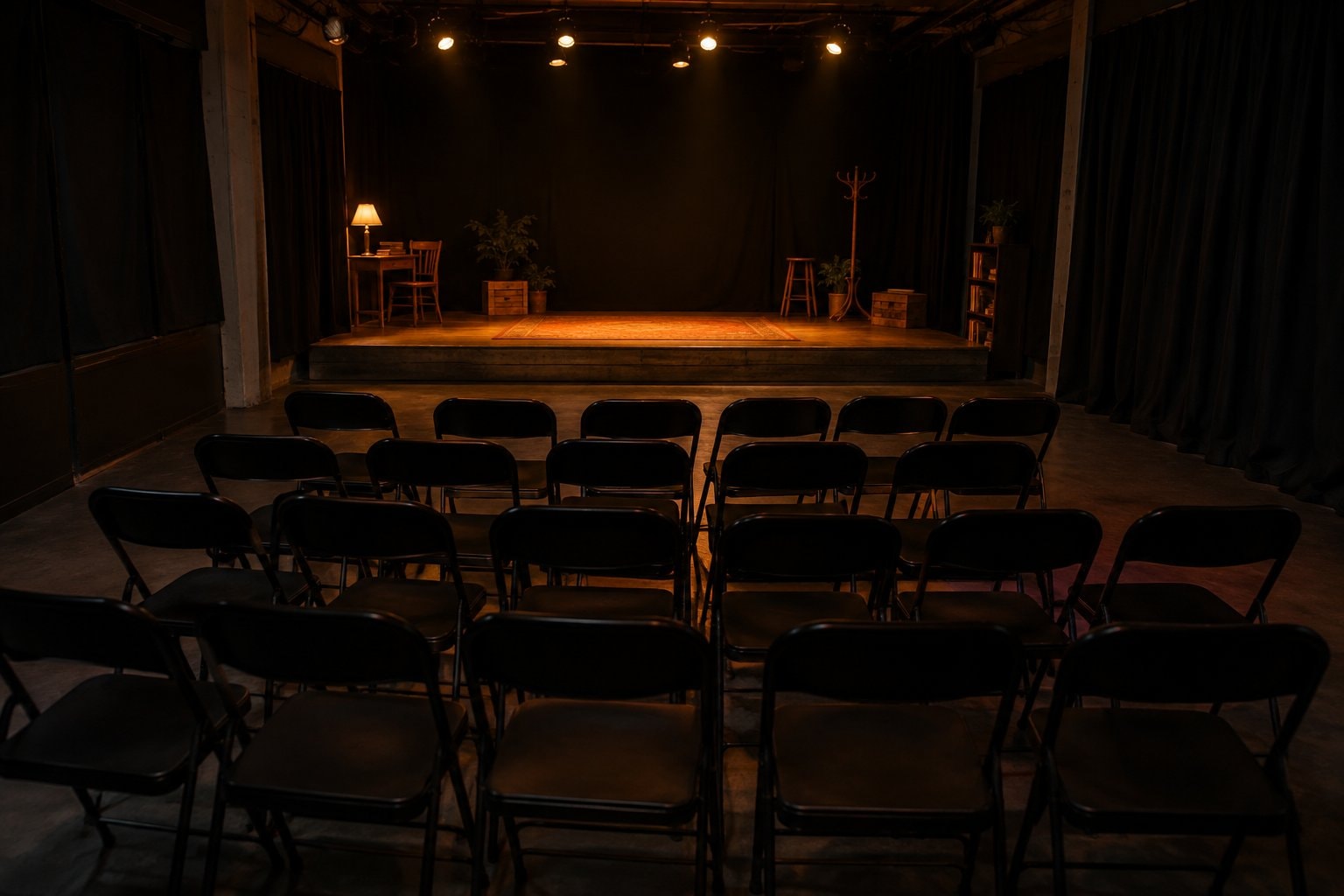
A small theatre can be understood as a relationship between a playing area and the people watching it. Elaborate scenery is not what makes that relationship possible. In an improvised scene, a largely empty floor leaves room for the performers to establish a place through speech and movement. The physical room remains simple while the imagined room changes.
A converted shop adds another layer: a building made for a different purpose becomes a place for performance. Wikipedia's account of adaptive reuse describes this change of use in existing buildings. The phrase concerns the building, rather than a particular style of theatre. A former commercial interior can retain its shell while its everyday functions change around the needs of a stage and an audience.
A room that can change its shape
A black box is a flexible performance space rather than a promise of a particular experience. Wikipedia's black box theatre article describes a plain room with dark walls and a flat floor that can accommodate different stage and seating arrangements. It also identifies converted storefronts among the spaces used for this kind of theatre. The important quality is the room's capacity to support different arrangements, not an ornate architectural identity.
The audience may face a playing area from across the room, sit along its sides or surround it. Each arrangement changes what a gesture looks like. A sideways glance that is clear from the front can be hard to read from behind. A scene played across a wide floor asks the audience to shift its attention differently from a scene contained near the seats. The space gives the same material a different scale.
That flexibility also gives rehearsal a practical subject. A performer has to understand which edge of the floor belongs to the scene and where an entrance will read as an entrance. The room may have no built door for a character to pass through. Its boundaries can still become clear through consistent action. The article on watching longform considers how those choices appear from the audience's side.
Seats and sightlines
A sightline is the line of view between a seat and the action. A close room makes small expressions visible, but closeness does not make every seat equally clear. A low platform can distinguish the playing area from the seating floor. Chairs arranged without that change of level create a different relationship: the performers and spectators share much the same plane.
The meaning of a seat is also social. A row aimed toward a stage establishes a common direction of attention. A more enclosing arrangement makes the audience's reactions visible to other spectators as well as to the cast. The room can feel like a place where everyone is listening to the same unfolding event. That feeling comes from how the performance and seating meet, rather than from a claim that a small theatre is always more intimate.
In a shopfront conversion, windows can remain part of the shell without remaining part of the view. Covered glass allows a room to become visually distinct from the street outside. The purpose of describing that arrangement is to explain how attention is framed. No particular shop, street or theatre is needed to make the relationship understandable.
Light gives the bare floor a focus
Stage lighting has work to do even when scenery is minimal. It can make the action visible, distinguish an area of the floor and give the scene a mood. Wikipedia's account of stage lighting describes these as functions of the craft. A bright central area draws the eye toward an exchange; a dim edge can leave performers visible without making them the focus of the moment.
A small room puts those choices close to the audience. The same light can fall on a face, a chair and the wall behind them, so the whole composition matters. An improvised location is not literally manufactured by a colour change. Light can instead support the fiction that the performers have already established, giving the action a place to gather.
When a set contains scene changes, a change in attention can matter as much as a complete change in light. A performer steps away, another scene begins elsewhere and the audience follows the movement. Technical work and ensemble timing meet at that transition. A room's limited equipment does not remove the question of focus; it makes the available choices easier to see.
Companies and the work around a stage
Community theatre encompasses work made by, with or for a community. The reference account of the form includes groups working in borrowed rooms as well as permanent facilities. Small community and fringe companies can use converted spaces as a practical home for rehearsal and performance. That is a general relationship between scale and space, rather than a description of a named company's arrangements.
The room's public life also extends beyond what happens during a scene. Moving chairs, keeping the floor usable and arranging technical work are part of the activity around a performance. The discussion of improv ensembles looks at the shared work of a group from another direction. A stage may be a visible focal point, but the surrounding labour helps explain how a room becomes a theatre in use.
Local building and fire rules apply. The visual simplicity of a black box does not settle those requirements or make a room suitable by itself. The term describes a kind of performance space, not a permission to convert an interior without the relevant local process.
The wider arts setting
Public arts funding belongs to the wider context in which small performance spaces exist. The National Endowment for the Arts describes its role as an independent federal arts agency supporting arts participation and practice. That role does not imply that any theatre described here receives funding from it. A general account of funding is distinct from an assertion about a particular recipient.
The page on Phoenix's stages and arts agencies places rooms for performance beside institutions and public bodies. Seen at that scale, a small converted space is part of a larger conversation about where live work happens. Its character still comes down to concrete things: the floor available to an ensemble, the audience's view and the light that lets a scene take shape.