Longform improv asks an audience to follow an evening while its meaning is still taking shape. A detail may seem small when it appears and significant when it returns. A scene can end without settling every question because its characters or themes remain available later. The pleasure can lie in recognising a connection just as the performers find it.
This guide runs no shows or audience events. The subject here is the experience of watching, described without a venue, calendar or invitation. Knowing some of the form's signals makes it easier to understand what a room is following, but the audience does not have to judge the performance against a hidden set of rules.
A suggestion is material, not a finished plot
Wikipedia's article on improvisational theatre describes audience suggestions as a frequent starting point for performers. A word or idea gives the ensemble material to interpret. It does not usually provide the whole story. A suggestion can lead toward an association, an image or a relationship that is not a literal depiction of the original word.
That distance is part of the form's imaginative work. An audience can recognise the starting material without demanding that every scene illustrate it directly. The performance may move toward the mood surrounding an idea or an unexpected contrast within it. A returning detail can reveal a connection that was less obvious at the beginning.
Audience participation also has a boundary. An offered suggestion is a contribution at the point when the performers request it. Ongoing conversation from the seats changes a different part of the room: the space in which other spectators are listening. The ordinary etiquette of attention makes room for the cast's work and for the audience around them.
The scene changes without a curtain
Longform often marks a transition through a performer's movement rather than a large technical change. The general reference account describes signals such as a performer crossing in front of an ongoing scene or tapping another performer in or out. Such actions are edits: visible ways of saying that the performance's attention is moving.
A transition can change the place, the time or the characters while leaving the physical floor much the same. The audience recognises the new scene through how the performers behave. An imagined table belongs to the previous room until the new scene establishes its own surroundings. The continuing stage does not mean that the fiction is continuing in the same place.
The glossary's terms for edits and scene work put names to those signals. The names are useful after the fact, but watching mainly involves following the action. Someone leaves, another relationship begins and the room's attention shifts. A clear transition can communicate its function before a spectator knows what it is called.
Connections can arrive late
In Wikipedia's account of the Harold, characters and themes recur in connected scene passages, with connections becoming more explicit as the form develops. Earlier scenes supply material that later scenes can use differently. The beginning therefore does not need to explain the whole evening's shape.
A character's return gives the audience recognition, but recognition alone is not the only point. A new circumstance can reveal something about the character's first appearance. An image can move from a literal object to a broader pattern. The audience may laugh at the remembered detail and at the altered meaning it now carries.
The article on longform formats looks at the Harold's framework in detail. From the seats, its structure can feel like an accumulation of shared memory. The ensemble and audience know more of the evening as it continues. A late scene can make use of that knowledge without pausing to explain every reference.
A plain room leaves space for invention
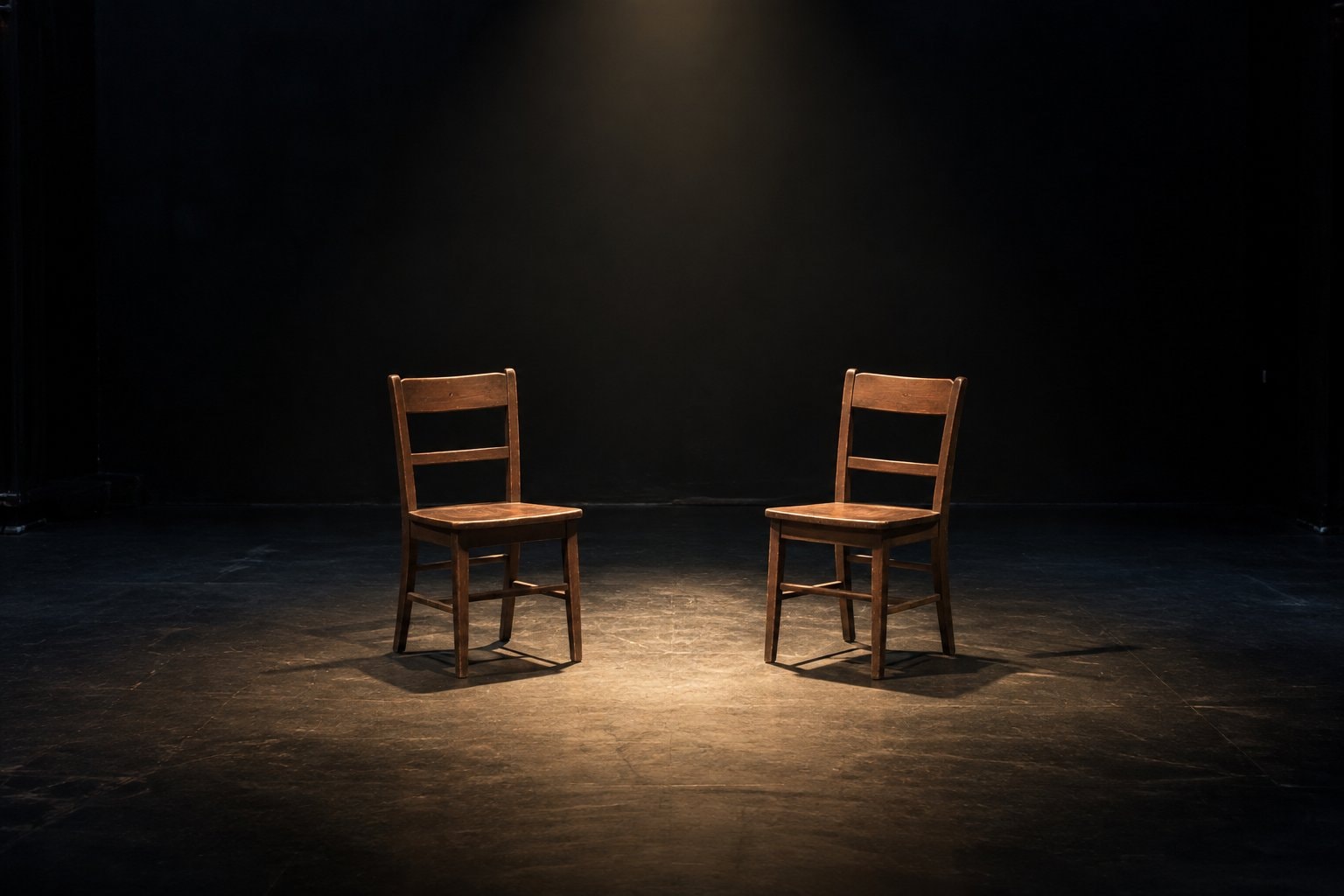
Wikipedia's black box theatre article describes a simple, flexible room where different stage and seating arrangements are possible. A room of that kind can suit unscripted theatre because the performance is not tied to elaborate scenery. A chair remains a chair physically while its imagined role changes from scene to scene.
Closeness also changes the scale of what an audience can see. A small gesture or a moment of hesitation can remain readable without becoming a broad announcement. At the same time, performers have to account for where the seats are. The article on the storefront stage examines sightlines and light as part of that relationship.
The sparse setting does not mean there is nothing to look at. The body becomes a main source of information. Posture can suggest a character's outlook, a repeated gesture can establish an object and a held glance can give a relationship its tension. The room's emptiness leaves those choices available to the audience.
Laughter and attention belong to the room
The general reference account of laughter describes it as both a physical behaviour and a social signal. In a performance, reactions can become part of the atmosphere shared by spectators and cast. A laugh marks that something has been recognised, though silence can also mean that the audience is closely following the scene.
No particular response is owed to every line. An audience can attend to a quiet exchange as well as an obvious comic turn. The guide's discussion of improv marathons considers how an extended evening changes the experience of that attention. Across different lengths and forms, watching remains an encounter with an event whose particular course is being found in public.