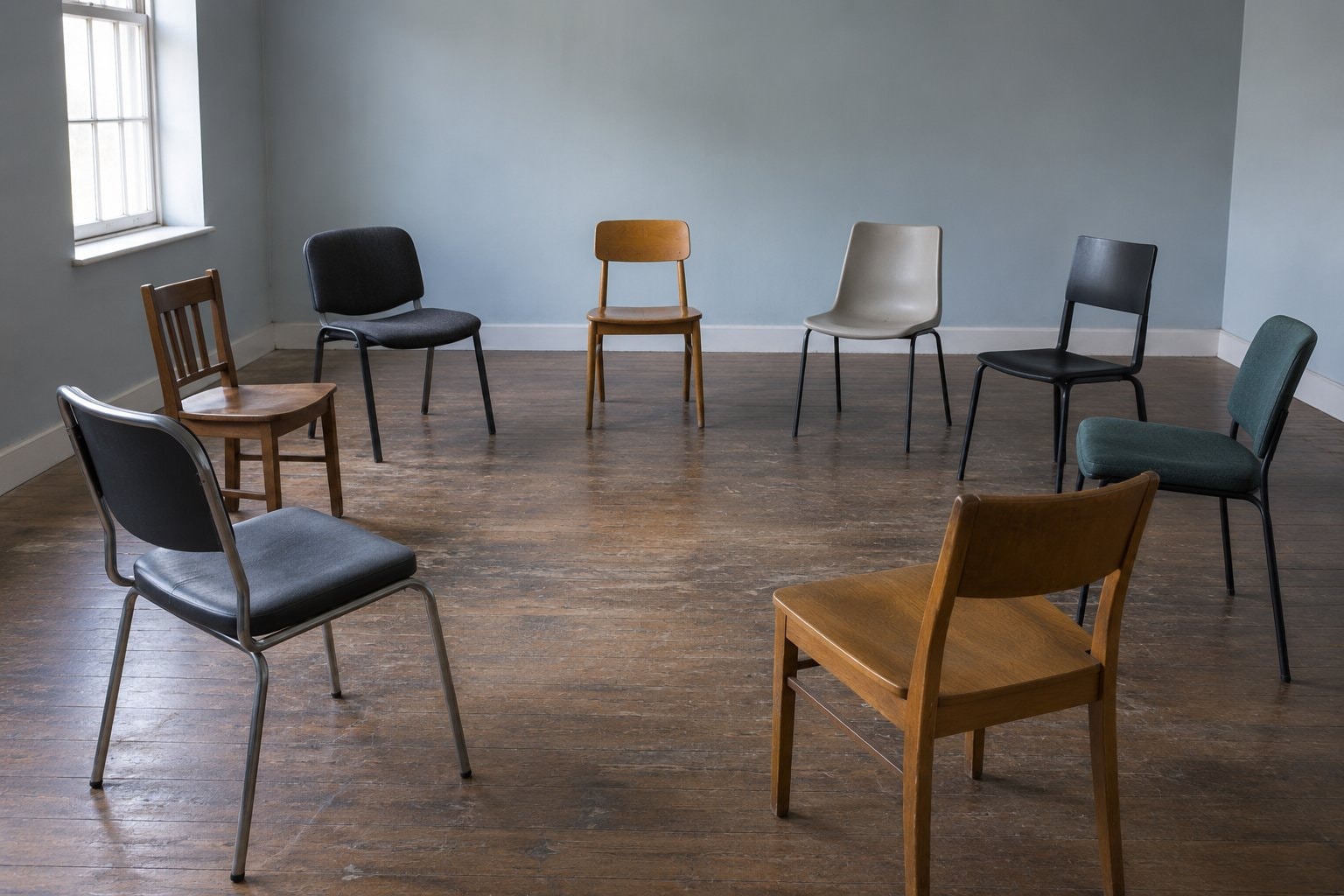
An improv team is more than a cast available to speak. Its members share responsibility for what the audience sees, what the scene has already established and where attention goes next. A performer at the side of the stage may be as involved as a performer in the middle. Listening from that position can reveal a returning detail, an unfinished relationship or a moment when the scene has reached its end.
The ensemble has no completed script to distribute those responsibilities. Its working habits make the difference between a collection of separate ideas and an evening that feels shared. Those habits include recognising an offer, accepting the imaginary setting and noticing a partner's change of emphasis. The improviser's toolkit explains the scene skills behind these choices. A team gives them a continuing social and artistic context.
Beat one: finding a shared way to play
Teams can form through an existing theatre, through study or through performers deciding to work together. A house team belongs to a theatre's ongoing performance arrangements. An independent ensemble chooses its own working identity and artistic interests. These are descriptions of how a group is organised, rather than rankings of skill or seriousness.
Wikipedia's article on the Upright Citizens Brigade describes its Harold Teams as house ensembles that perform regularly. The same article traces the organisation's beginnings to ImprovOlympic in Chicago and its later move to New York. The example shows how an ensemble can be connected both to a theatre and to a particular longform structure, without every team needing that structure.
iO Theater, formerly ImprovOlympic, provides a related reference point: it is a theatre and training centre, and its history includes the formation of teams and a shift toward longform. The general lesson for understanding ensembles is that a shared place to rehearse, teach and perform can shape how groups emerge. It does not make all groups artistically alike. A format is a common frame; an ensemble supplies the particular responses inside it.
A shared approach may concern pace, character, physical space or the kinds of connections the players notice. Some groups tend toward quiet relationships. Others favour abrupt changes or broad patterns. Such tendencies do not have to be agreed as a finished plan. They can become visible through what performers repeatedly accept, leave room for and return to. An ensemble's style is partly the history of those decisions.
Beat two: rehearsal without a finished script
Rehearsal makes the team's habits easier to recognise. It gives players a setting in which the aim can be a craft question rather than the response of an audience. The subject may be how clearly a place is established, how an edit changes attention or whether a character's behaviour follows from the relationship. The scene itself remains newly made. Rehearsal concerns how the group handles that uncertainty.
A coach can watch from outside the playing area and describe something the performers cannot easily see while acting. A note about an unclear relationship is different from a judgement about whether a player is funny. Useful craft language points to an observable choice: a detail was introduced, a response changed its meaning, or an entrance drew attention away from an existing exchange. That language gives the group something definite to discuss.
Wikipedia's account of improvisational theatre describes scene-making as a responsive process in which performers accept and add to each other's offers. Ensemble trust can be understood in that practical sense. A player acts on the expectation that a partner will take a contribution seriously enough to use it. Trust does not require the partners to predict every decision or have identical tastes.
Group mind is a useful theatre phrase when it means shared attention. A pause, movement or returning idea becomes legible to the ensemble because the players are following the same developing scene. The phrase need not suggest thought-reading or a mysterious collective state. Agreement about the imagined place, characters and recent events supplies enough common ground for separate responses to belong together.
The players outside a scene remain part of its structure. An entrance can supply a needed relationship; an edit can leave a strong moment intact; a return can reveal that an earlier detail matters. Support also includes leaving room. A crowded scene can have plenty of invention while making the central exchange harder to follow. Ensemble work concerns the audience's attention as well as the distribution of speaking.
Beat three: change is part of an ensemble
A continuing team is not a fixed personality. Members bring different interests to rehearsal, and the balance changes when a performer leaves or another arrives. A group may discover that the style which suited its earlier membership no longer feels clear. It can also change simply because familiar choices have become too easy to anticipate. None of this requires an account of personal conflict to make artistic sense.
Longform supplies a way to hear those changes. The guide to longform formats describes structures that connect scenes through themes and returning elements. A team's relationship with a structure can deepen, loosen or move elsewhere. The question is how its present members make shared choices inside the form, rather than whether they preserve a past sound.
Wikipedia describes community theatre as theatre made by, with or for a community. It offers a parallel for understanding ensemble life: the work belongs to a set of relationships, not only to a production. Community theatre and improv are distinct descriptions, but they can overlap in the importance placed on people making theatre together.
The account of how improv is taught follows the connection between games, scene work and ensemble practice. Study provides craft language; rehearsal gives that language a particular group to describe. A team becomes recognisable through those continuing choices, while each performance remains open to something its members have not planned.